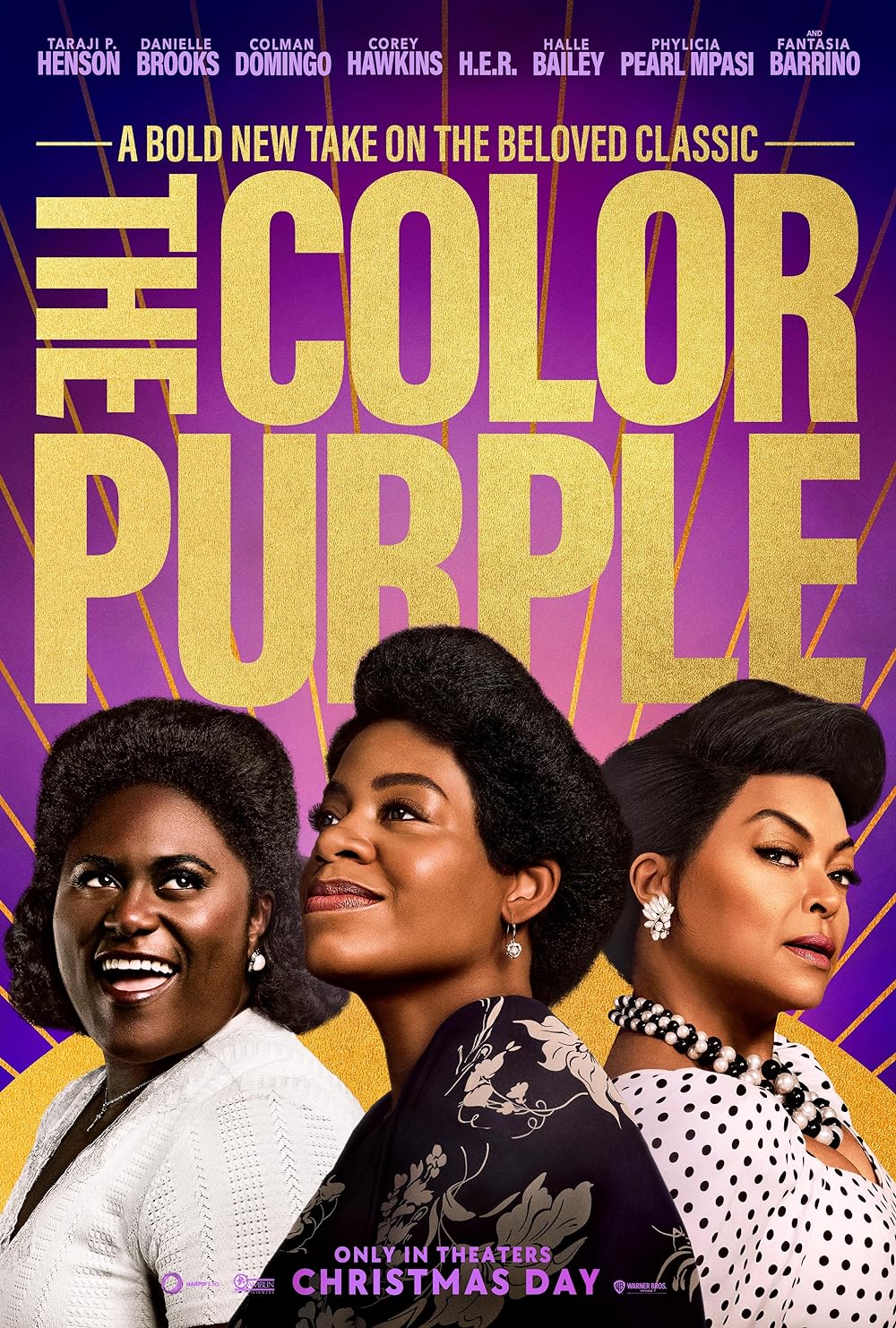
The Color Purple
The Color Purple is based on the hit Broadway musical, which was based on Steven Spielberg’s 1985 film, which was based on Alice Walker’s best-selling novel. That’s a lot of based ons! It’s also a testament to the strength of the author’s tale. How many stories could go through that many iterations and remain excellent? Director Blitz Bazawule gives the movie a visual style and a tone all its own, while remaining faithful to Walker’s core ideas.
A prologue introduces us to Celie (Phylicia Pearl Mpasi) and Nettie (Halle Bailey), close-as-close-can-be sisters who get torn apart by Mister (Colman Domingo), the controlling older man Celie has been forced to marry. Years later, Celie (now played by Fantasia Barrino) is stuck in an unhappy existence filled with abuse and misery. She finds support in the form of Shug Avery (Taraji P. Henson), a singer whose life is anything but glamorous despite outward appearances, and Sofia (Danielle Brooks), the outspoken wife of Mister’s adult son Harpo (Corey Hawkins). The women go through a series of personal crisis that include racism, poverty, and abusive men.
Obviously, this is not your typical happy-go-lucky musical. It deals with heavy subject matter. The powerful songs draw upon gospel, jazz, and blues – styles that are appropriate to the early 1900s time period, as well as to the emotional content of the women’s respective journeys. Cinematic staging is very different from theatrical staging. Bazawule uses elegant camera movements and frame compositions to draw us closer to the characters during the intimate numbers. Carefully chosen locations for each one similarly help to achieve an ambiance. Watching people break out into song amid such high drama could come off corny. Instead, the musical sequences are designed to play like the inner feelings of these folks are being unleashed. Barrino, in particular, gets a show-stopping number during the third act that might have you reaching for some tissues.
The Color Purple has its work cut out for it in the performance department. Whoopi Goldberg, Oprah Winfrey, and Margaret Avery all received Oscar nominations for their outstanding work in Spielberg’s adaptation. Amazingly, this new version manages to live up to that standard. Barrino forcefully conveys Celie’s trauma, while Henson captures the way Shug puts on a façade of elegance to cover her own pain. If there’s a standout, however, it’s Brooks. Early scenes of Sofia showing fearlessness hauntingly contrast with later ones in which her spirit is unexpectedly broken. Brooks makes both sides of the equation authentic.
Maybe the biggest compliment I can pay the film is that it feels like its own thing, despite the well-known source material. The characters and situations may be familiar, yet I got sucked in by the distinct vibe it creates. I didn’t care about Celie, Shug, and Sofia because I enjoyed the previous movie; I cared about them because these actresses make them real people, and because this screenplay tackles the themes meaningfully, and because this director knows how to tell the story with flair. Like a great cover song, the movie puts an individual spin on something recognizable.
Hardships faced by the women pack a punch, and that maximizes the uplifting nature of the finale. The Color Purple’s central theme is survival. Our heroines go through the wringer. Their spirits don’t die, though. What a beautiful idea, especially when conveyed musically. I can’t imagine anyone not being touched by this inspirational film.
out of four
The Color Purple is rated PG-13 for mature thematic content, sexual content, violence, and language. The running time is 2 hours and 20 minutes.