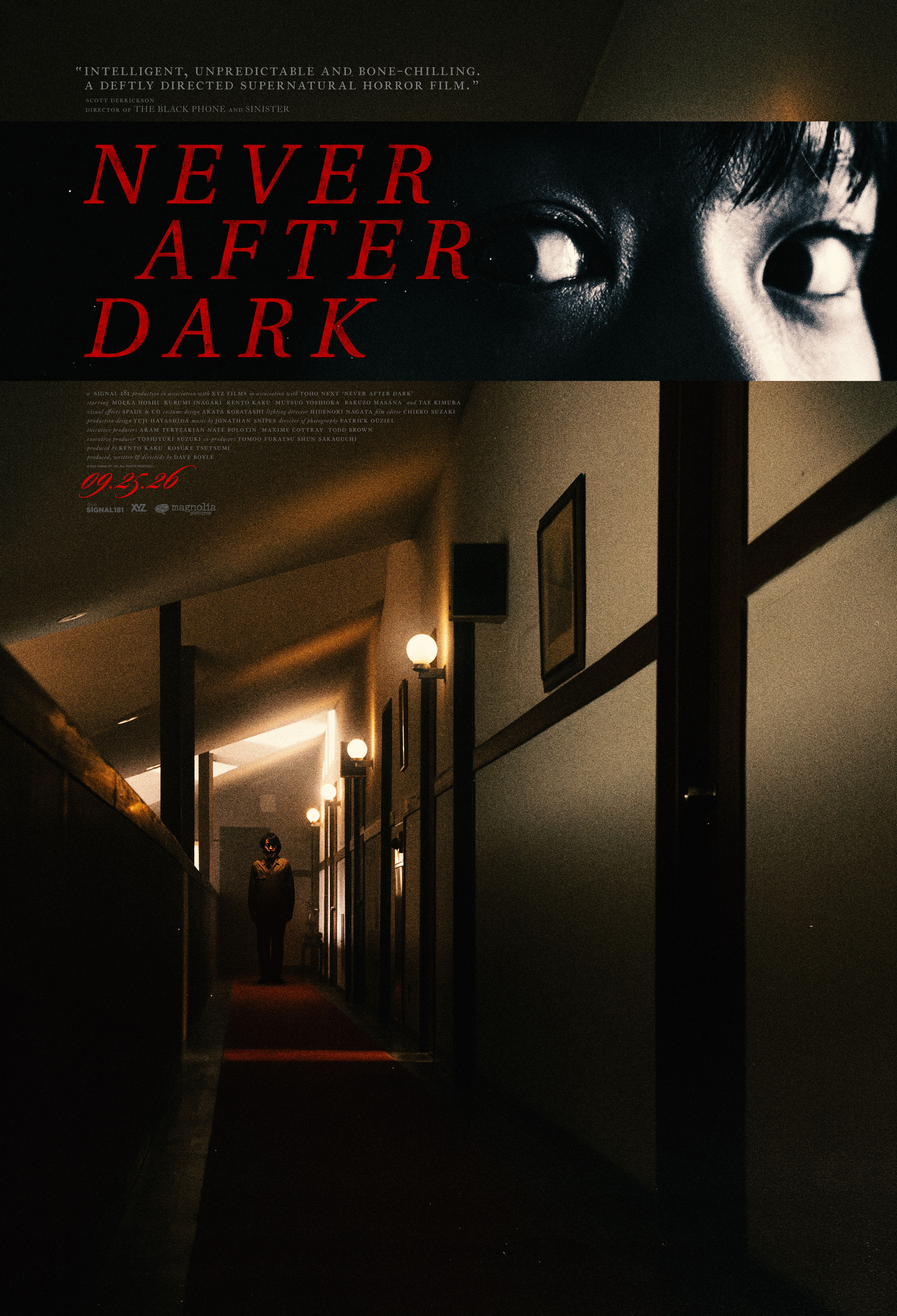
Never After Dark
Never After Dark is one of the more hypnotic ghost stories to come down the pike in a while. This Japanese import avoids the paranormal cliches that have grown tiresome in post-Conjuring cinema, instead creating an ever-present sense of psychological dread that springs as much from the human characters as it does from the supernatural ones.
Airi (Moeka Hoshi) is a traveling psychic who helps people get rid of ghosts. Often assisting her is the spirit of her deceased sister Miku (Kurumi Inagaki), with whom she regularly converses. (We see Miku reflected in windows and mirrors.) Airi is hired to come to a large, remote house by its new owner Teiko (Tae Kimura) and her son Gunji (Kento Kako). They want her to remove a ghost from the premises. She agrees, but on the condition that Teiko and Gunji leave while she works. Because the “veil” between the living world and the afterworld is too thin at night, she only operates during the daytime.
The freshest element in Never After Dark is that Airi isn’t even remotely afraid. She’s done enough of these gigs to know ghosts don’t pose much threat. Humans, on the other hand, make her very nervous. That contrast proves particularly impactful as she discovers the ghost, a figure with a massive open wound for a mouth that keeps trying to claw into a cabinet in one of the rooms. Her hosts continually popping in, hoping to see her at work, suggests they might be up to something more menacing than the spirit.
Writer/director Dave Boyle takes his time with the story, allowing it to generate slow-burn suspense. His means of depicting Airi’s work is eerie. She traverses worlds by hypnotizing herself with a spinning zoetrope, then tracks the spirit through the house, trying to ascertain what it wants. That set-up later opens the door for a harrowing sequence in which Airi races to blow out a candle that will bring her back before she gets stuck in the afterlife. The movie’s third act delivers more traditional shock moments that build meaningfully on the mysteries of the first two.
Moeka Hoshi plays Airi perfectly, capturing how the character is more comfortable with the dead than with the living. She also suggests the inner pain that comes from having lost Miku. The film is, in many respects, a character study of Airi – how this case changes her and how she is forced to confront things she’s been avoiding. Hoshi injects emotion into the role, adding another layer to the scary elements.
Atmospherically photographed and loaded with unpredictable twists, Never After Dark is a ghost story with a soul. It gives you the big-time creeps.
out of four
Never After Dark is unrated, but contains violence/gore. The running time is 1 hour and 45 minutes.
© 2026 Mike McGranaghan