Whalefall
I read Daniel Kraus's novel Whalefall last summer and wasn’t wild about it – not because it wasn’t well written but because I simply couldn’t visualize the interior of a whale’s digestive system. And since that’s where most of the story takes place, it was a bit of a problem. The movie adaptation, from Spontaneous director Brian Duffield, takes care of the visualization aspect, while holding on to the book’s emotional core. I feel like I can finally fully appreciate the harrowing nature of this tale.
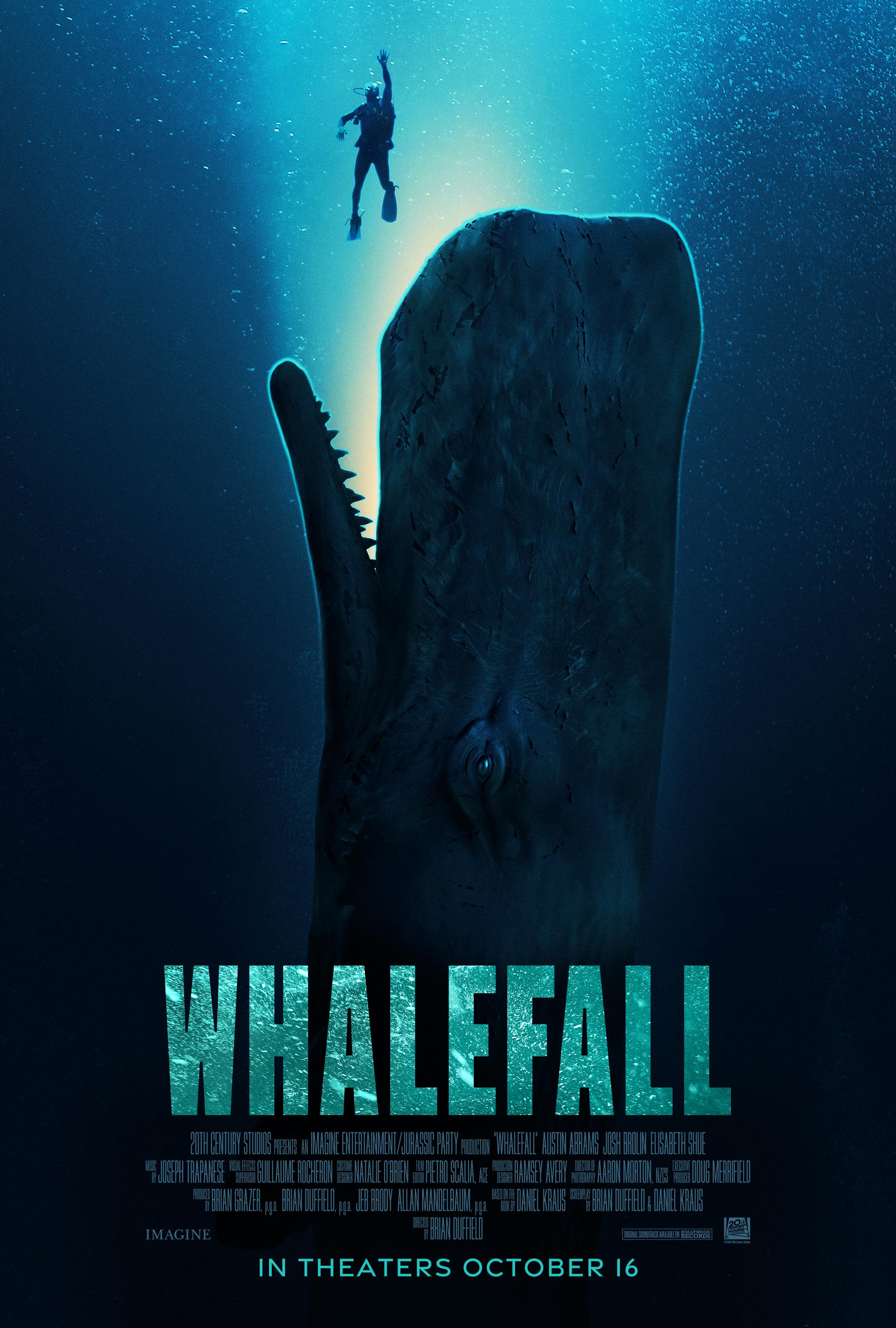
College student Jay Gardiner (Resident Evil’s Austin Abrams) is reeling from the death of his father Mitt (Josh Brolin) one year ago. Their relationship was fractious, with Jay often made to feel as though he didn’t measure up to his grizzled dad’s standards. Nonetheless, he has decided to dive into the part of the ocean where the terminally ill Mitt drowned himself, hoping to recover the remains so mom Zara (Elisabeth Shue) and sisters Eva (Jane Levy) and Nan (Emily Rudd) can feel closure. While down there, he is swallowed by an 80-foot sperm whale. There’s only an hour’s worth of oxygen in his tank, meaning he has to work fast to find a way back out.
Whalefall is definitely a movie that plays on fears of deep water and tight spaces. The creature dives, leaving a lot of water in its stomach with Jay, along with jellyfish and various pieces of detritus it swallowed. There is nobody to call for help in the ocean. Much of the time, Jay finds himself being nearly squashed by the whale’s innards, which repeatedly constrict as it tries to digest the contents inside. That provides for multiple make-you-crazy moments of suspense, including one where Jay is attacked by an octopus that has also been swallowed.
CGI obviously had to be used for external shots. Much of the whale’s interior was created practically, and the effects team deserves a round of applause for building these squishy, disgusting locations. It looks gross in there, a quality that adds immeasurably to the film’s squirm factor. At times, I recoiled in my seat because the effect was so powerful.
At its core, the book is less about Jay getting swallowed by a whale than it is about how, in this dire situation, he recognizes that Mitt gave him all the tools he needs to survive. The movie emulates the novel’s structure, utilizing flashbacks to show Mitt was a tough SOB who thoroughly trained his son in the art of diving. Those skills have suddenly come in handy. Duffield taps into strained parent/child dynamics, as well as the way we sometimes don’t fully appreciate the lessons our mothers and fathers taught us until we’re older – or until they’re gone. For all the thrilling adventure on display here, you may well find yourself getting choked up during the big finale.
Austin Abrams gives a miraculous performance in the lead role. He’s onscreen alone much of the time, given minimal dialogue. The actor still manages to convey Jay’s terror, his grief, and the way his mind is perpetually looking for a means of escape. If Abrams’ work wasn’t of high quality, the whole thing would fall apart. Thankfully, it’s very high quality. Josh Brolin is excellent, too. In his hands, you feel that Mitt loves Jay, despite their frequent clashes.
You can’t get around the fact that a couple parts of Whalefall are inherently silly. It is, after all, about a guy trapped inside a whale. A touch of silliness doesn’t matter too much, given that the excitement is frequent and the emotions are strong. Giant cinema screens and surround sound systems were invented for pictures like this. It's a tense ride.
out of four
Whalefall is rated PG-13 for peril, violent content, bloody images, some strong language, and thematic content. The running time is 1 hour and 46 minutes.
© 2026 Mike McGranaghan